

HYROX Exercises Explained: The 8 Stations, Weights and How to Train for Them
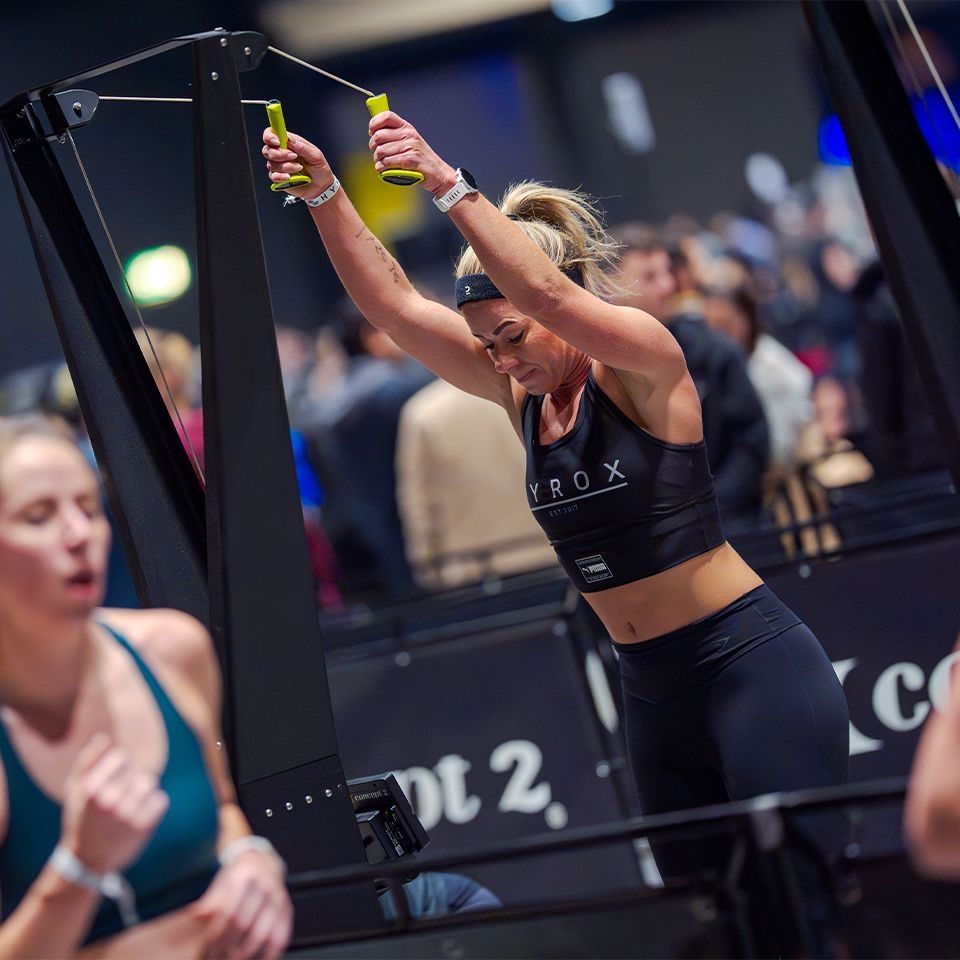
If you’re new to HYROX, understanding the exercises is the first step to training with confidence.
HYROX follows a fixed race format that includes:
- 8 × 1 km runs
- 8 functional workout stations
Because the order and structure never change, once you understand the HYROX exercises, you can train specifically for race day.
In this guide, you’ll learn:
- all 8 HYROX stations explained
- the weights used in each division
- how to practise HYROX exercises as a beginner
- technique tips to improve performance
- common mistakes to avoid
What Are the HYROX Exercises?
HYROX consists of 8 functional workout stations performed between 1 km runs.
The 8 HYROX stations (in order)
- SkiErg – 1,000 m
- Sled Push – 50 m
- Sled Pull – 50 m
- Burpee Broad Jumps – 80 m
- Row – 1,000 m
- Farmer’s Carry – 200 m
- Sandbag Lunges – 100 m
- Wall Balls – 100 – final station
Each station tests a different combination of:
- endurance
- strength
- coordination
- pacing under fatigue
How Hard Are HYROX Exercises?
HYROX exercises are designed to be simple but physically demanding.
The movements themselves are not highly technical, but the challenge comes from:
- completing them under fatigue
- maintaining consistent pacing
- transitioning efficiently between stations and runs
This makes HYROX accessible for beginners, while still challenging for experienced athletes.
The 8 HYROX Stations Explained (With Training Tips)
1. SkiErg (1,000 m)
Why it matters
Sets your rhythm early in the race.
Technique tips
- hinge at the hips, drive through the legs first, then arms and back with full range of motion
- maintain a smooth, consistent cadence
- avoid sprinting too early
How to practise
- 3 × 500 m at steady pace after light running
2. Sled Push (50 m)
Why it matters
One of the most physically demanding stations.
Technique tips
- keep your body low and stable
- use short, powerful steps
- take brief pauses if needed
How to practise
- repeat short distances (e.g. 4 × 12.5 m) with controlled pacing
3. Sled Pull (50 m)
Why it matters
Tests grip strength, posture and coordination.
Technique tips
- lean slightly back and brace your core
- pull hand-over-hand smoothly
- maintain balance and control
How to practise
- short repeated pulls focusing on technique rather than speed
4. Burpee Broad Jumps (80 m)
Why it matters
Combines cardio with explosive movement.
Technique tips
- maintain a steady rhythm
- step up if needed to control fatigue
- avoid overextending each jump
How to practise
- timed intervals focusing on consistency
5. Row (1,000 m)
Why it matters
An opportunity to regain control if paced well.
Technique tips
- hinge at the hips, drive with legs first, then body, then arms
- keep strokes smooth and controlled
- avoid pulling too hard too early
How to practise
- 2–3 × 750 m at even pacing
6. Farmer’s Carry (200 m)
Why it matters
Challenges grip strength and posture.
Technique tips
- keep shoulders engaged and posture upright
- take small, controlled steps
- avoid rushing turns
How to practice
- short carry intervals with brief rest
7. Sandbag Lunges (100 m)
Why it matters
Tests lower body strength and control.
Technique tips
- keep torso upright
- control each step
- drive through the front heel
- your knee must hit the ground with every lunge
How to practice
- shorter distances focusing on balance and consistency
8. Wall Balls (Final Station)
Why it matters
The final challenge that often determines your finish time.
Technique tips
- use leg drive to generate power
- aim for consistent depth and accuracy
- break into manageable sets
How to practice
- structured sets with short rest intervals
HYROX Weights by Division
While distances and repetitions stay the same, weights vary depending on division.
Example (Open vs Pro)
Sled Push (50 m)
- Women Open: ~102 kg
- Men Open: ~152 kg
- Women Pro: ~152 kg
- Men Pro: ~202 kg
Farmer’s Carry (per hand)
- Women Open: 16 kg
- Men Open: 24 kg
- Women Pro: 24 kg
- Men Pro: 32 kg
Wall Balls
- Women Open: 4 kg
- Men Open: 6 kg
- Women Pro: 6 kg
- Men Pro: 9 kg
Exact weights may vary slightly by event, so always follow official race standards.
How to Practise HYROX Exercises as a Beginner
You don’t need to replicate the full race straight away.
Start by focusing on:
- correct technique
- manageable distances
- consistent pacing
Beginner approach
- reduce weights on sleds and carries
- shorten distances where needed
- use interval formats (e.g. EMOM or timed sets)
- prioritise movement quality over intensity
As your fitness improves, you can gradually build toward full race simulations.
Common HYROX Exercise Mistakes
Going Too Hard Too Early
Start controlled to avoid early fatigue.
Poor Technique Under Fatigue
Focus on maintaining movement quality, especially on sleds and lunges.
Ignoring Grip Strength
Farmer’s carries and sled pulls rely heavily on grip endurance.
Inconsistent Wall Ball Sets
Break into repeatable sets rather than pushing to failure.
Practising HYROX Exercises in the Gym
Most HYROX exercises can be trained in a well-equipped gym.
Key equipment includes:
- sleds
- rowing machines
- SkiErgs
- kettlebells
- sandbags
- wall balls
At Genesis Health + Fitness, Coaching Zone sessions incorporate many of these movements into structured workouts. Coaches can guide members on technique, pacing and progression so they can build confidence across all HYROX stations.
Frequently Asked Questions
What are the 8 HYROX exercises?
The 8 HYROX stations are:
- SkiErg
- Sled Push
- Sled Pull
- Burpee Broad Jumps
- Rowing
- Farmer’s Carry
- Sandbag Lunges
- Wall Balls
Can beginners do HYROX exercises?
Yes. The movements are simple and can be scaled by adjusting weight, distance and intensity.
What equipment do I need to train for HYROX?
Most training can be done with standard gym equipment including sleds, ergs, kettlebells, sandbags and wall balls.
What are the best shoes for HYROX?
Choose stable, grippy training shoes that perform well for both running and functional movements.
Ready to Start Training for HYROX?
HYROX may look intense, but once you break down the exercises, it becomes simple, structured and highly trainable.
With the right approach, you can build:
- confidence in each movement
- consistent pacing
- the endurance needed to complete the race
At Genesis Health + Fitness, Coaching Zone sessions provide structured, coach-led training that helps members practise HYROX-style exercises in a supportive environment.
Book a Coaching Zone session at your nearest Genesis club and start building your HYROX fitness today.
Category List
Your New Beginning (11)
fitness goals (3)
business (2)
Find Your 30 (30)
lifestyle (11)
competition (2)
sleep (1)
wellness (98)
Press Release (14)
genesis team (3)
wellbeing (2)
Health Advice (2)
Programs & Products (1)
Weight Loss (41)
genesis community (5)
food (8)
Gym (5)
Exercises (2)
self care (2)
Fitness (134)
gym owners (2)
Fitness Solutions (19)
reformer (2)
recipe (2)
Plank (1)
Workout (2)
transformation (1)
reformer pilates (5)
strength (1)
group training (1)
news (2)
nutrition (49)
Genesis Ballarat (1)
Community (12)
Group (2)
challenge (4)
training (4)
Yoga (3)
Rehabilitation (1)
Strength and Tone (54)
productivity (1)
health (123)
weight loss transformation (1)
franchise (3)
